
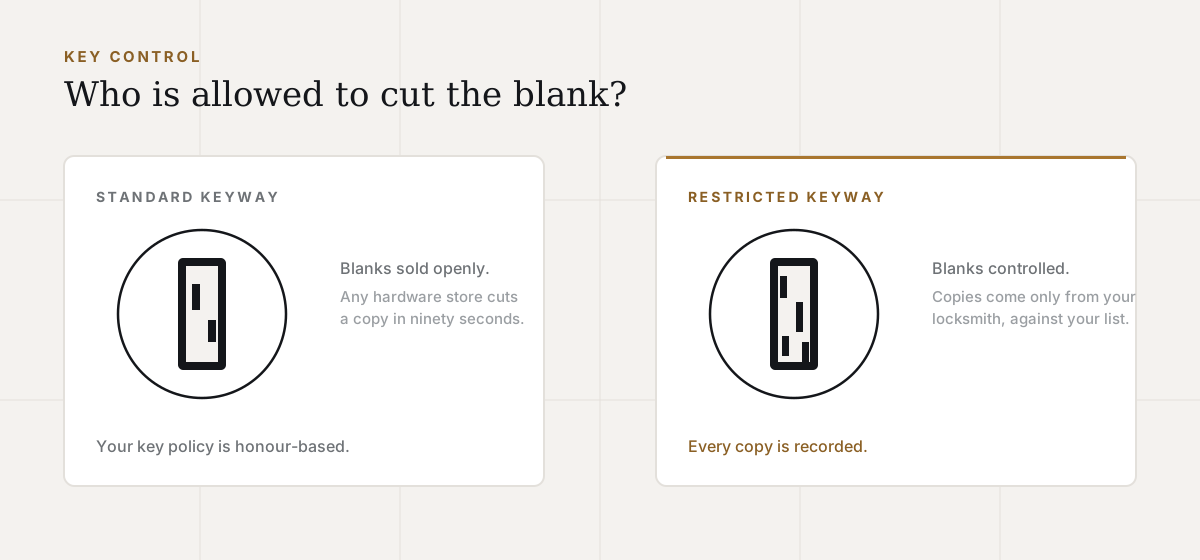
A restaurant owner called us after a third round of inventory shrinkage. Good hardware, deadbolts everywhere, a manager’s key policy in writing. And a standard keyway, which meant every key in the building could be copied at any hardware store, grocery kiosk or big-box counter within two miles.
There was no lock problem. There was a key problem.
The thing nobody mentions when they sell you locks
Standard keyways — the common commercial and residential profiles — have blanks sold openly to anyone. That is convenient, and it is why a hardware store can cut you a spare in ninety seconds.
It also means your key control policy is entirely honour-based. Anyone who holds a key for ten minutes can hold two keys forever. You will never know, because your original comes back.
For a lot of businesses that is an acceptable risk. For anywhere with cash, inventory, controlled substances, customer data or after-hours staff, it is not.
What restricted actually means
A restricted keyway uses a key profile whose blanks are not sold on the open market. They are distributed to a specific locksmith, under contract, tied to your system.
Practically:
- A hardware store cannot cut your key. They do not have the blank, and their machine does not have the profile.
- Copies come from us, against an authorisation list you control.
- Every copy is recorded — who requested it, who received it, when.
- An unauthorised request gets a phone call to you, not a key.
Some restricted profiles are also patent-protected, which adds a legal barrier to blank manufacture on top of the distribution one. Those are the ones worth having.
Who this is for
- Restaurants — high turnover, late hours, cash on site, walk-in and liquor storage.
- Retail and strip centers — stockrooms, shared back corridors, multiple tenants with one landlord key.
- Manufacturing and fabrication — tool cribs, chemical storage, expensive portable equipment.
- Storage facilities — where the entire product is controlled access.
- Property managers — whose master key is the single most valuable key in the portfolio.
- Medical and professional offices — records access is a compliance question, not just a security one.
The one-line version: if your master key can be duplicated by anyone who borrows it, the master key system is documentation, not security.
What it costs, honestly
More than standard hardware. The cylinders cost more, the keys cost more, and there is a records process behind it. For a small retail space you are typically looking at the cost of the cylinders plus labour — not a building-wide replacement, because in many cases we retrofit restricted cylinders into the hardware already on your doors.
The comparison worth making is not against standard cylinders. It is against one incident: a night deposit that disappears, a stockroom that walks, or an insurance claim where you have to explain your access control.
How to phase it in
You do not have to do the whole building at once, and most of our accounts did not.
- Start with the doors that matter — exterior, cash office, stockroom, server closet.
- Add the master level, so management keys are restricted even where individual doors are not yet.
- Convert the rest at turnover, as hardware fails or tenants change.
We keep your restricted cylinders and blanks in customer-specific inventory, so phase two next year does not start with a special order.
The part that makes it work
A restricted system is a relationship, not a product. It only functions if someone maintains the authorisation list, records every key issued, and collects keys when people leave. We hold the technical side; you hold the list. That division is the whole point — neither of us can quietly hand out a key.